SHOW THE RECORDContent record — click to inspect
Human × AI · A practical example

You shouldn’t have to play detective.

A burger has ingredients. An ad has sources, permissions, edits, and people who approve it. A receipt gives you a place to start when something goes wrong.

It also gives the creator and company a fair way to show what they actually did.

Inspect an ad receipt ↓
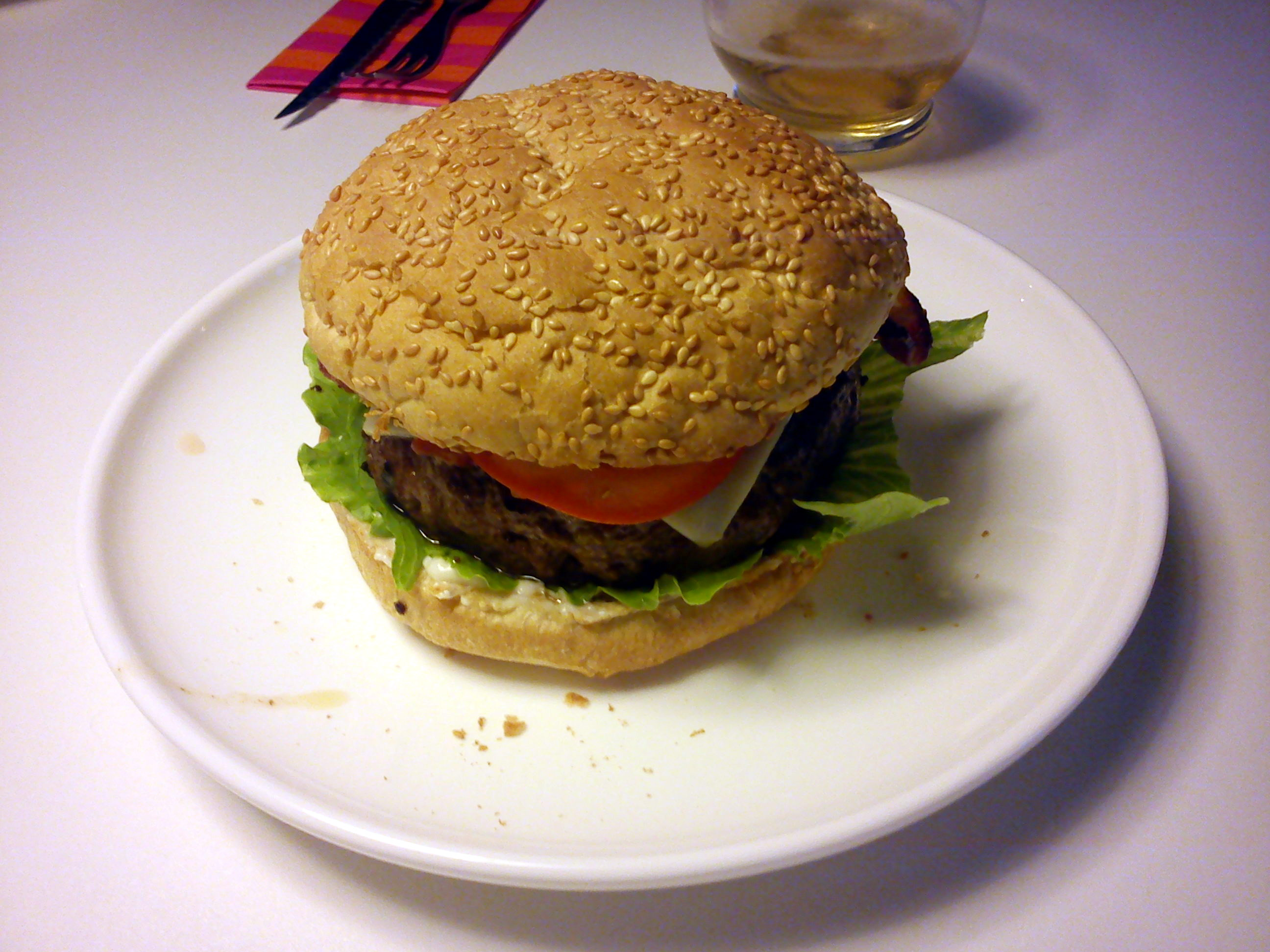
A sesame-bun hamburger on a plate

Photo: cyclonebill / Wikimedia Commons. CC BY-SA 2.0. Resized. Original.

Illustrative placement prototypes

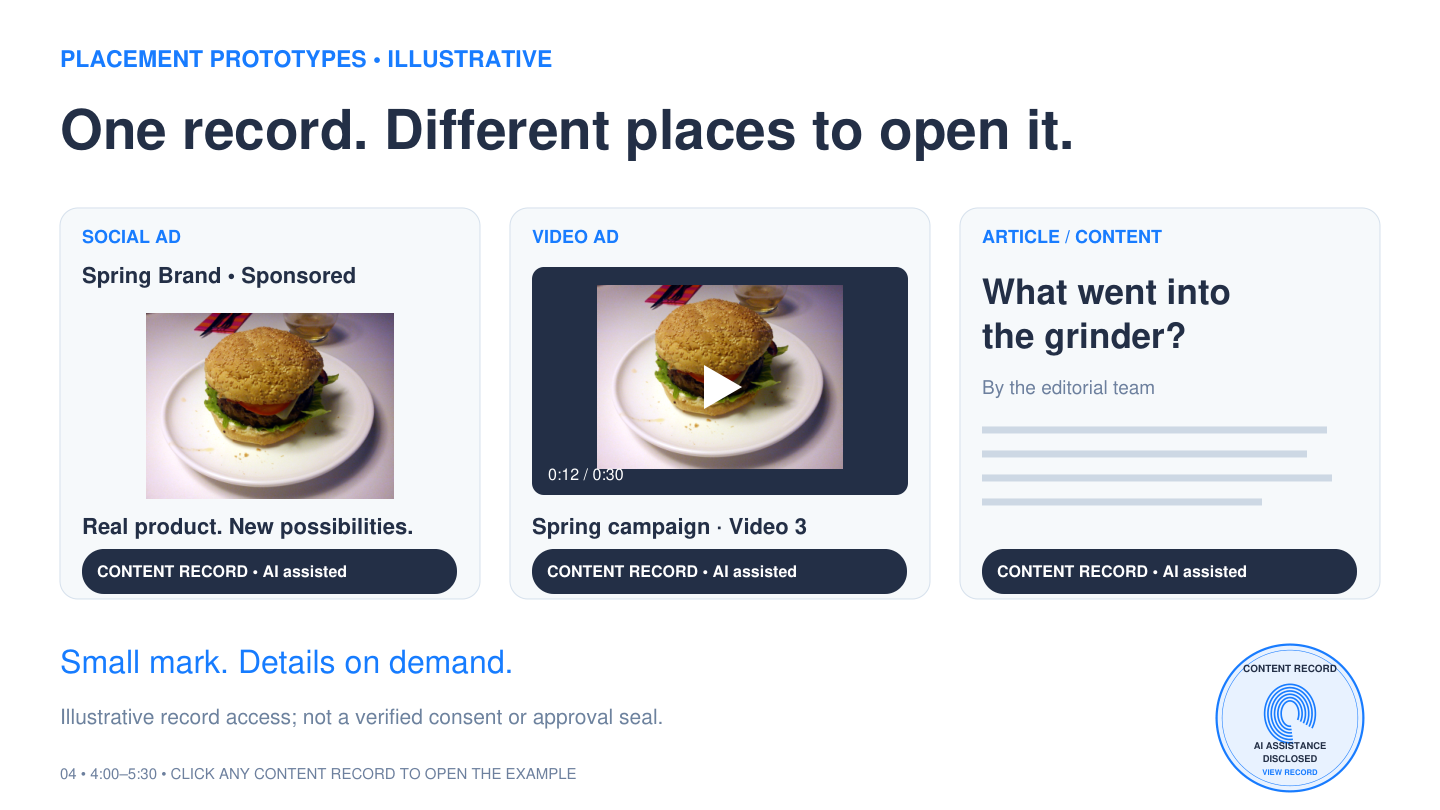
One mark across ads, videos, and articles.

The visible mark opens the same structured record. These mockups show proposed placement, not a verified consent or approval certificate.

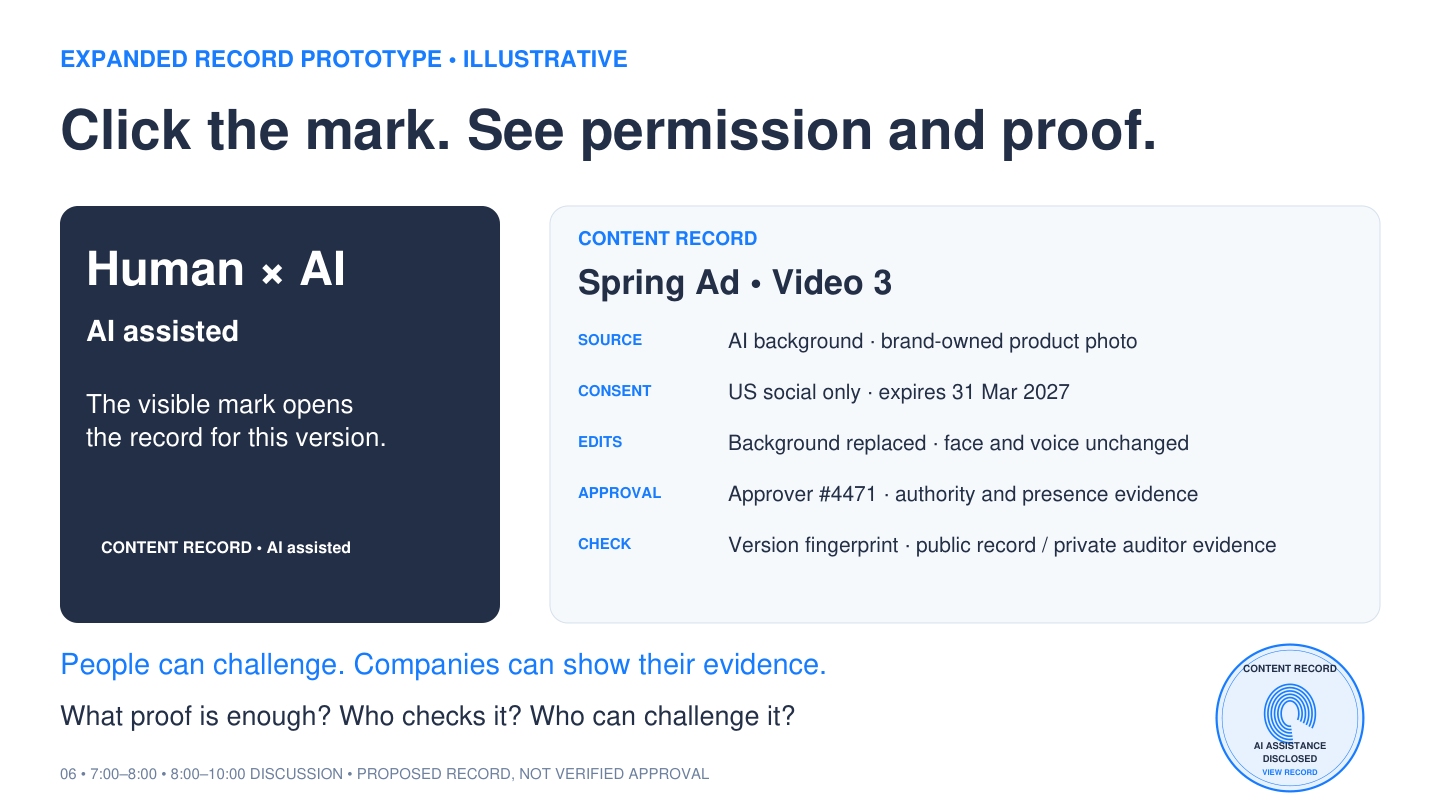
Content record marks on a social ad, video player, and articleExpanded content record with source, consent, edits, approval, and verification
Fictional case · proposed workflow

Spring Ad, Video 3

An actor challenges the use of their likeness. Start with the record, then hear each party. The sample facts below are invented; they are not a verified approval.

Human × AI assisted

Illustrative receipt · brand authorization proposed

Where it came from
AI-generated background, 2 Oct 2026. Product photograph supplied by the fictional brand.
Permission
Sample consent: US social ads through 31 Mar 2027. No face or voice alteration. Consent status must be checked at use.
What changed
Background replaced. Actor’s face and voice unchanged in the approved version.
Who approved this version
Approver #4471 · Content Integrity Reviewer · sample approval at 10:42. Identity, presence-check evidence, and delegated authority would stay with the organization.
Which asset
Version 3 · fingerprint would bind the approval to the exact ad file.
What the public can check
Scope, status, edits, and signatures when implemented. An auditor would review protected supporting evidence under controlled access.

What does each person need?

The receipt supports a decision. It does not assign blame automatically or replace a fair investigation.

Change one fact. See what should happen.

From evidence to action

  1. Protect: assess harm and pause disputed use when appropriate.
  2. Preserve: keep the ad, approval, consent, placement, and edit logs.
  3. Hear: let the actor, creator, reviewer, and brand respond.
  4. Decide: identify who controlled the disputed step and explain the outcome.
  5. Repair: correct, withdraw, re-review, or reinstate; record the response and any appeal.

An insurer can inspect this trail against the actual policy. A receipt does not create insurance coverage.

A practical alignment example

The visitor said no. Did the system listen?

Someone declines tracking, but a marketing tool still collects data. The team compares the person’s choice with the system’s behavior, corrects the mismatch, and tests again.

That is a practical alignment test: compare what someone allowed with what the system actually did. A policy or approval record alone cannot show that the live system followed it.

Applying the lesson to an ad receipt — Jay’s synthesis
QuestionEvidence to retainWho acts?
What was allowed?Consent choice, purpose, scope, timestamp, and policy version.Privacy owner confirms the rule; the person can challenge it.
What actually happened?Observed tags/events or ad placement, edits, version, and timing.Technical owner checks the behavior. Separate observation from suspected cause.
Where did they differ?A reproducible mismatch, affected uses, and known evidence gaps.Marketing, privacy, and engineering review together; hear the affected person.
Who corrects it?Named fix owner, change made, rationale, and completion date.The team controlling that configuration remediates; leadership supplies authority and resources.
Did the correction hold?Test result, subsequent observations, and checks after releases.Recheck and reopen if the mismatch returns. Keep the response and remedy in the record.

The ad version of this test: Was the actor’s likeness used only as permitted? Did the published version match the one approved? Did the distribution stay within scope? If it changed, who reviewed it again?

Illustrative example: permission, observed behavior, correction, and a check that the correction worked.
Why now · consequences

Disclosure is already a legal obligation in some markets.

EU and US state rules impose different marking and disclosure duties. A label can answer “was AI used?” without establishing permission, a person’s authority, or who controlled a disputed use.

Penalties and disputes

Keep the applicable rule, disclosure decision, consent scope, and delivery evidence. Assess actual obligations by jurisdiction and use.

IP and likeness

Source and permission records help a rights holder challenge misuse and help a creator or company show agreed use.

Insurance

Optional generative-AI exclusions can affect advertising-injury coverage. Compare the evidence with the actual policy; the receipt does not make an ad insurable automatically.

Alignment after approval

The record should follow changes and delivery. An earlier approval cannot establish that every later placement or edit stayed in scope.

Proposal for discussion

A LUMAscape that rewards evidence.

Layer 3 sets the stops. Layer 4 attaches the proof. Layer 5 uses it. The shared receipt connects the commercial roles below.

Creators and tools

Disclose origin and edits. Retain license and ownership evidence.

Brands and agencies

Require permission and approval for the exact version. Preserve the record through handoffs.

Platforms and ad tech

Carry and check the record; expose status and routes to challenge.

Auditors and verifiers

Test assertions against protected evidence and explain uncertainty.

Insurers and buyers

Evaluate evidence and risk against actual contracts and policies.

People and rights holders

Inspect use, challenge misuse, and seek correction without surrendering public privacy.

The proposed incentive: purchasing, distribution, and risk review should value checkable proof. This is a discussion proposal, not an existing certification or a promise of lower premiums or better reach.

Who sets the minimum record? Who checks the checkers? How can small creators participate without prohibitive cost?

The everyday examples behind the proposal

Diamonds: same carat does not answer mined or lab-grown, origin, or quality. Art: a convincing Picasso needs supporting provenance and authenticity evidence. Used cars: “one careful owner” invites a request for service and accident history. Hamburgers: mixed ingredients need a reconstructable source trail. These analogies explain the instinct; they are not engineering specifications.

Inputs, contributions, and evidence

Who supplied what—and how we used it.

Jay’s article supplies the narrative. The technical contribution attributed to Sean supplies the proposed checks and privacy model. This table traces the rest of the inputs. Contribution does not mean verified approval.

Some discussion notes do not identify the speaker. Those stay joint or unspecified; we do not invent individual credit. The fictional ad case is separate from the actual production record.

Source and contribution register
Source / contributorInput suppliedDetails usedRole in the deck / demoEvidence status
Jay MandelMystery Meat, Mystery Data — supplied articleHamburger / grinder analogy; diamonds, art, used-car history; source ≠ truth; carrying evidence forward.Opening narrative and limits of the receipt.Named author in supplied article.
Jay MandelDirections and revisions in this conversation10-minute format; practical accountability; stakeholder empathy; IP protection; badge terms; dogfooding seal and example site.Editorial direction, case framing, visual design, and demo requirements.Direct instructions; final human approval not recorded.
Sean Meier / VRFDTechnical contribution described in the supplied discussionCreator disclosure; source collection; watermark and Gen AI / deepfake signals; private organization-bound biometric methods; organization-scoped approver ID; C2PA carriage.Proposed Source → Review → Receipt flow and privacy boundary.Attributed technical proposal; speaker-by-speaker authentication not supplied. No controls verified here.
VRFDVRFD-Mockups.html — supplied mockupsVisible label and presence-receipt designs.Design reference for opening evidence from a mark.Mockups, not proof of deployed capabilities. Exact authorship not established from the file.
Joint / working notesLayer 4 technical conformance presentation and supplied receipt textSource, permission, approval, changes, public checks / auditor evidence; fingerprint, authority, presence; open questions.Receipt fields and stakeholder investigation example.Working proposal. Unlabeled discussion is not assigned to a specific speaker.
Joint / working notesLayer 4 companion / rules notes supplied 11 Oct 2026Existing standards, experimental controls, drafts, gaps, regulation and insurance references.Background research map; separation of existing components from proposed end-to-end system.User-supplied research notes; not every cited item independently verified. Statements that no system exists are not established by this demo.
cyclonebillHamburger (5).jpg — Wikimedia CommonsHamburger photograph.Visual for mixed inputs and provenance.CC BY-SA 2.0; resized; source link and license below.
NWRGeekMassachusetts Elevator Inspection Certificate — Pass CardReal framed inspection-certificate photograph, 2012–2013.Visual analogy for inspector, date, authority, and validity.CC0; resized; historical certificate, not a current inspection.
C2PAC2PA / Content Credentials explainer and specificationProvenance, asset binding, edit history, signatures, and verification limits.Technical reference for carrying records; supports distinguishing provenance from truth.Primary standard documentation; this demo does not issue C2PA credentials.
ChatGPT / OpenAIAssistance in this conversationDrafting, synthesis, PDF / website code, case wording, fingerprint implementation, and drawn seal.Production assistance; fictional scenarios and implementation.AI assistance disclosed. Not an independent auditor or human approver.
Example case — inventedSpring Ad, Video 3; approver #4471; actor consentSample background edit, permission scope, approval time, and stakeholder dispute.Shows how records could support fair review and corrective action.Fictional values. No actual actor consent, approver identity, or biometric check.
Published artifactThis exact presentation PDF and record.jsonSHA-256 fingerprint; disclosed workflow, sources, and verification gaps.Allows matching a file copy to the published record.Byte-level check implemented; no signed approval, identity proof, or presence proof.
Operational alignmentIllustrative consent scenarioCompare permission with observed behavior, assign correction, and recheck.Explains how teams use evidence to hold decisions accountable.Illustration, not a verified deployment or third-party endorsement.
Rawpixel / public-domain sourceDiamond photograph, image 5913653Faceted diamond product photographVisual on the workstream progress pageSource labels image CC0 / public domain; responsive display. Source.
Links and license details

Jay’s article, Sean-attributed discussion, working notes, original deck, and VRFD mockups were supplied to this conversation. They are identified here without publishing the source files or private correspondence.

Additional references named in the supplied working notes

These are the research inputs named in the companion notes. Inclusion records their role; it does not claim that the prototype implements them or that every supplied interpretation was verified.

  • IAB AI Transparency & Disclosure Framework V2 — disclosure policy and risk test.
  • C2PA 2.4 ingredients, actions, and asset binding; Content Credentials Verify / c2patool — provenance carriage and checking.
  • Google SynthID; Reality Defender removal test (vendor report) — watermark / detector context, not detector proof in this demo.
  • W3C ODRL 2.2 — permission scope and conditions.
  • HAPS Sep 2026; NIST SP 800-63-4 — presence and identity research context.
  • W3C VC 2.0; SD-JWT; CAWG vLEI draft; CAWG Identity Assertion 1.3 — authority and identity assertion references.
  • Trust Stack Layers 3, 5, and 6; Proof-of-Control working draft; IAE AIRS — governance, accountability, verifiability tiers, and incidents.
  • EU AI Act Articles 50 and 99 / EC FAQ; California SB 1000, AB 2713, AB 853, SB 1050; New York synthetic-performer disclosure — regulatory context.
  • ISO CG 40 47 / 40 48 — optional generative-AI insurance exclusion context; actual coverage depends on the policy.
Actual production disclosure · incomplete verification

Inspect our content record.

AI assistance disclosed — inspect the record

Here is the record for the presentation that brought you here. We can disclose the process and verify the file’s bytes today. We have not implemented the full certificate system.

Human × AI assisted

Human direction
Jay Mandel supplied his article, examples, and revision instructions. This records direction, not verified final approval.
AI assistance
ChatGPT drafted wording, wrote PDF and website code, and assembled sourced photographs and drawn vector symbols.
Image sources
Hamburger: cyclonebill, CC BY-SA 2.0. Elevator certificate: NWRGeek, CC0. Historical certificate from 2012–2013. Both resized for the slides.
Human sign-off
Not recorded.
Proof of presence
Not performed. No biometric data collected.
Signed credential
No digital signature or C2PA credential issued.

Download the exact presentation Who supplied what? Read the record

Check the file fingerprint

Compare the PDF’s SHA-256 fingerprint with the published record. A match confirms the same bytes. It does not prove ownership, truth, or human approval.

Loading the published fingerprint…

No check run yet.

Your selected file stays in your browser; it is not uploaded. The record is not digitally signed, so someone controlling the website could change both file and fingerprint.

The example does not run AI/deepfake detection, watermark recovery, biometric authentication, or private auditor access. Those controls need implementation and independent testing. No person’s private identity appears here.

Keep the claim smaller than the proof.

What do the badge terms mean?

AI assisted: human-led work with Gen AI help. AI generated: Gen AI creates the core content. AI free: no Gen AI in the declared workflow. These are proposed definitions; the workflow and boundaries should remain visible.

What does the receipt protect?

Creators can document ownership and agreed use. Actors can inspect consent and challenge misuse. Reviewers can show what they knew and their authority. Brands can reconstruct approval and correction. Auditors and platforms can assess evidence without publishing private identities. Consumers can see the status without investigating the entire supply chain themselves.

How does this relate to Content Credentials?

A production implementation could use C2PA to carry signed provenance. Provenance can support checking history and tampering; it does not establish that an ad’s claims are true. Human presence and authority require additional evidence. Read the C2PA explainer.

Open questions: What is the smallest useful record? Who checks it independently? Who can challenge it? How long should private evidence remain available?