Sentinel Insights · For outside counsel and in-house legal teams
Can you show what happened to the data?
Use Sentinel Insights to test what a website sends after an opt-out. Find problems early and pull up recorded activity if a client, customer, or regulator asks what happened.
Recommend a focused test tied to the privacy obligation you’re advising on.
Use the findings to ask better questions about vendor contracts and downstream use.
In-house counsel leading implementation
Pick one site or campaign. Agree with marketing and engineering on what to test and who owns the fix.
Save the findings and retest after changes so you have a record to review if an inquiry comes in.
A promise is easy. Show what happened.
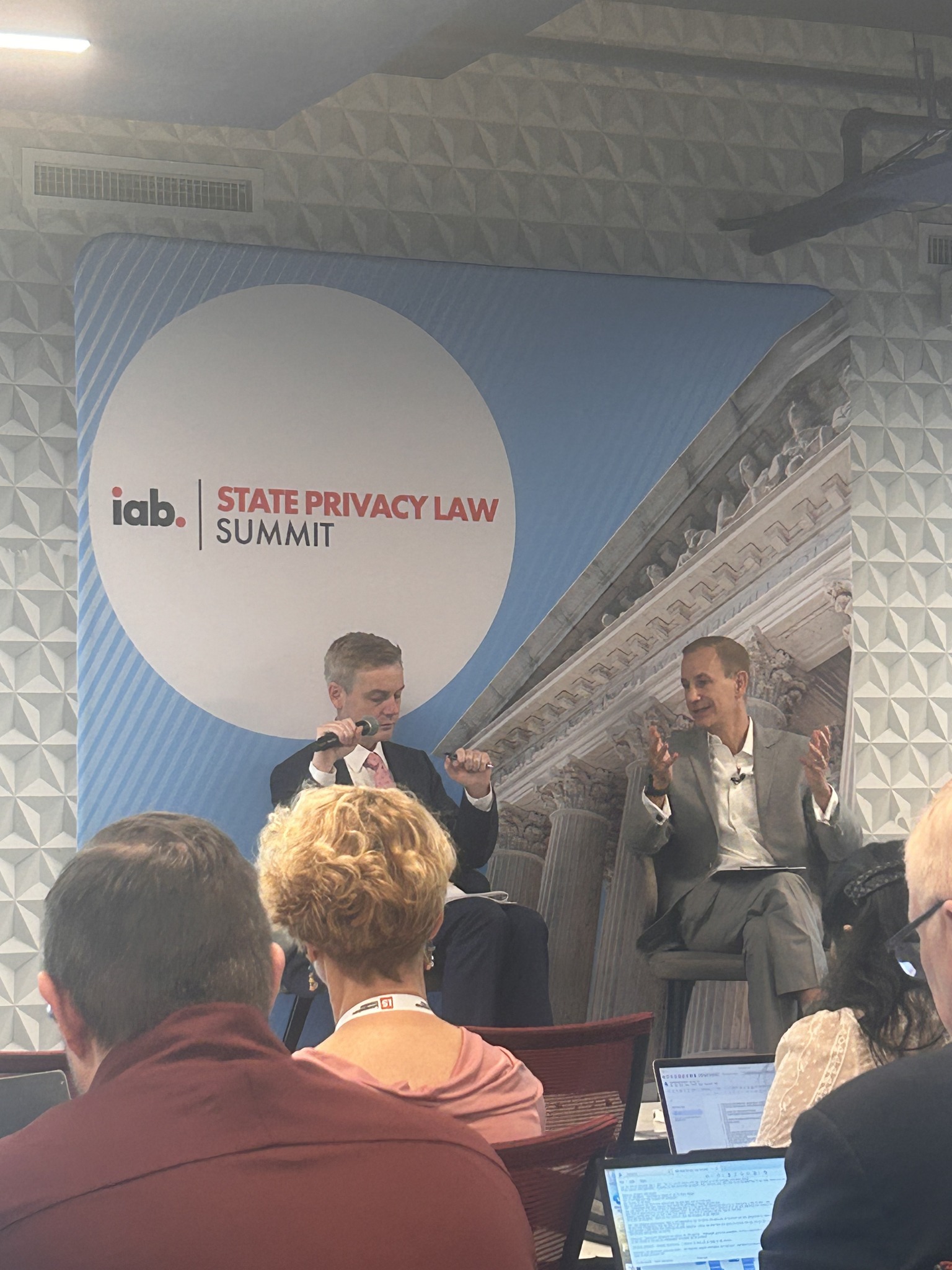
In his opening remarks at the 2026 IAB State Privacy Law Summit, Michael Hahn, executive vice president and general counsel at IAB and IAB Tech Lab, explained that questionnaires record what partners promise. It takes evidence from those partners to show how they actually used the data.
Michael Hahn, executive vice president and general counsel at IAB and IAB Tech Lab, and Delaware Deputy Attorney General John Eakins at the 2026 IAB State Privacy Law Summit.
The checklist “We’ll comply.”
The inquiry What data was sent, where did it go, and how was it used?
Before an inquiry
Test what fires after an opt-out. Review flagged requests, fix the issue, and run the same test again.
When an inquiry arrives
Log in to Sentinel and review the activity it recorded. Use the request details to see what was sent, when, and where. Ask receiving partners to document how they used it.
What Sentinel can find, in plain English
Someone says no. An ad tracker still runs.
What Sentinel can flag. A marketing tag, a piece of code on the site, runs after someone clicks “Reject cookies.”
Why it helps. Find the tag to fix, then run the same test again.
A request may include an email address.
What Sentinel can flag. A request may carry personal details the recipient doesn’t need.
Why it helps. Check who received it and stop sending unnecessary data.
Someone completes a form. The report misses it.
What Sentinel can flag. An expected signal, such as a form submission event, is missing.
Why it helps. Check if the tracking broke before judging campaign results.
What the evidence looks like
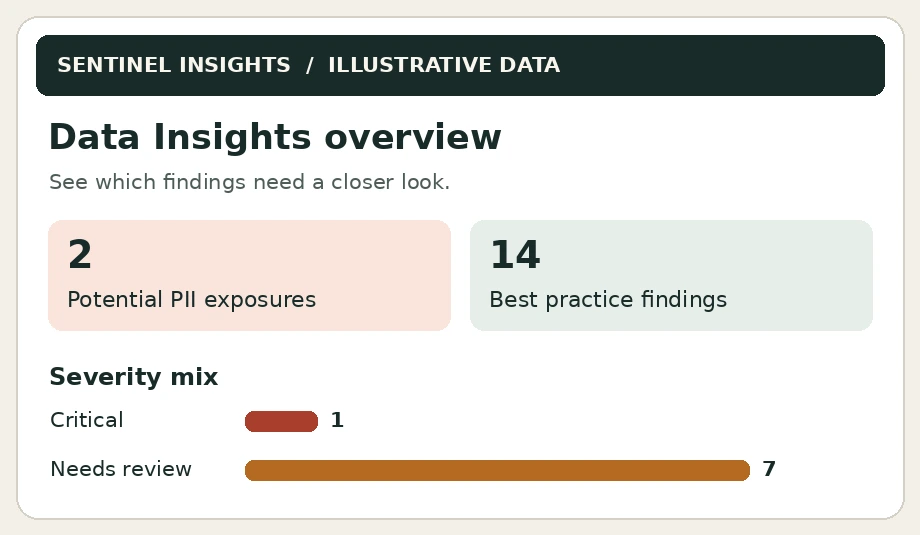
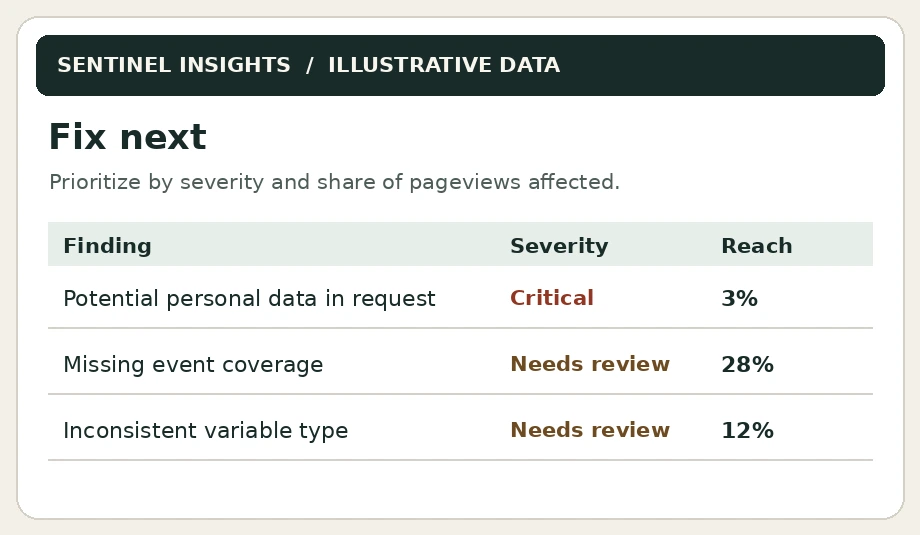
Two views from a typical demo, illustrated with fictional data.
Data Insights overview. See what the monitor flagged and how many checks need review.Fix next. A critical finding can take priority even if it affects fewer pageviews.
Walk through an example finding
Observe. A marketing tag fires after a visitor rejects cookies.
Check. Review the tag and request details to see what left the page.
Follow up. Ask the receiving partner for a redacted record showing how it handled the request.
Retest. After the tag is fixed, repeat the same consent choice and check the result.
What ignoring privacy can cost your business
New technology still has to follow the law. A new tool can move personal data faster or in a different way. Every transfer still has to comply with the privacy rules that apply to it. Ask what data moves, who receives it, and how they can use it.
One campaign can pass data through several companies. A failure at one handoff can cost your business money and trust.
Money and time
Fines and legal costs. An investigation can bring penalties and legal bills, plus the cost of collecting records and responding to regulators.
Cleanup. Pay engineering, marketing, and privacy teams to trace requests, fix tags, retest consent choices, and update vendor contracts.
Lost revenue. Paused campaigns can cost sales. A buyer may delay a launch, hold a renewal, or choose another vendor while you explain what happened.
Trust and credibility
Customers stop believing the choices you give them. If “Reject” changes nothing, customers may share less, leave, or tell others what happened.
Partners ask for more proof. A brand or agency may require a fresh review, demand evidence of fixes, or take you off its approved vendor list.
Your word carries less weight. A public enforcement order can make your next privacy promise harder to believe, even after your team fixes the problem.
A real cost in California. American Honda agreed to pay $632,500 and change its practices to resolve California privacy allegations. The regulator cited obstacles to exercising privacy rights and missing privacy protections in contracts with ad tech companies. Read the Honda enforcement decision summary.
When a partner’s mistake can become your liability
If an ad tech partner misuses data you shared, regulators can also examine your choices. What did your contract allow? What did you check before sharing the data? What did you do when something looked wrong? Each company’s exposure depends on its role, its conduct, and the applicable law.
California. Due diligence can affect whether a business had reason to believe a service provider or contractor was misusing personal information. Separate protections for certain third-party disclosures depend on conditions including a qualifying written contract and what the business knew or had reason to believe when it shared the data. See California Civil Code § 1798.145 and regulations §§ 7051–7053.
Delaware. Starting January 1, 2027, covered controllers must conduct reasonable diligence on third parties they disclose personal data to. Review the questionnaire and relevant documents, take additional reasonable steps based on the data’s sensitivity, and secure a contractual right to stop and address unauthorized use. See Delaware’s controller requirements.
What Sentinel adds. Review what your site actually sent and where it went. Use those findings to ask what the recipient did, document its response, and verify the fix where you can observe it.
See California, Delaware, and multistate enforcement details
Start with the people whose data you handle. A state law may cover your business even if you’re headquartered elsewhere. Coverage and obligations depend on the law, the people and data involved, and the role your business plays.
California. Covered businesses must honor applicable requests to opt out of the sale or sharing of personal information, including qualifying opt-out signals. At the November 2026 rates, the CCPA allows administrative fines of up to $2,663 per violation, or $7,988 for intentional violations and certain violations involving consumers under 16. See California’s published fine amounts.
Delaware’s processor rule. A binding contract must govern a processor acting for a controller. The processor must provide evidence of compliance and cooperate with reasonable assessments.
Enforcement crosses state lines. California, Colorado, and Connecticut announced a joint investigation into businesses’ handling of opt-out signals. Read the regulators’ announcement.
Where each platform fits
IAB Diligence Platform
Assess vendors with advertising-specific questionnaires.
Review state privacy law assessments from SafeGuard Privacy.
See a consent test, the evidence Sentinel records, and what you can ask a vendor to document. We can focus on a client’s needs or how to start testing in-house.