Earn consumer confidence
81% of US adults said they were concerned about how companies use their data in Pew’s 2023 survey. Give people a record they can inspect and a way to challenge misuse.
Developing work · IAE Governance Lab · IEEE SA knowledge partnership
Follow the effort to connect what an AI system was allowed to do with what it actually did—and the people and companies responsible.
I’m Jay Mandel. I work with Sean Meier on Technical Conformance, Layer 4 of the developing AI Advertising Trust Stack. This page shares our contribution, examples, progress, and the questions still open.
Why companies would adopt it
81% of US adults said they were concerned about how companies use their data in Pew’s 2023 survey. Give people a record they can inspect and a way to challenge misuse.
Serious GDPR violations can bring fines up to €20 million or 4% of total annual global turnover, whichever is higher. Regulators can also restrict or ban processing.
The Dutch regulator announced a €30.5 million fine against Clearview AI in September 2024 for illegal collection for facial recognition. Publicly accessible images do not remove privacy obligations.
Scraping is not automatically illegal. The data, legal basis, rights, purpose and jurisdiction determine the obligations. Survey concern does not prove that people will click a seal or that this proposal will increase sales; adoption and consumer use need testing.
Connected standard / interactive proposal
The ambition: every brand adopts the same standard and links its ads to a shared record. Buyers, platforms and reviewers use that evidence to decide what can run. Select a fictional brand below to see how it could work.
Inspect sources, rights, edits and approval.
See which active ads pass, fail or need review.
Review compliance across the assessed campaigns.
Compare the evidence from agencies, tools and platforms.
Track adoption, recurring failures and correction times.
Open a broad status to reach the exact record behind it. Every result needs a defined scope and date. A passing ad cannot certify an entire company.
No evidence means “not assessed,” not an automatic failure. One failing active ad prevents a passing brand status within that review’s scope.
Brand record / ORCHARD
Both ad versions have current rights and approval records.
How the mark appears on an ad
Advertisement / AI assisted
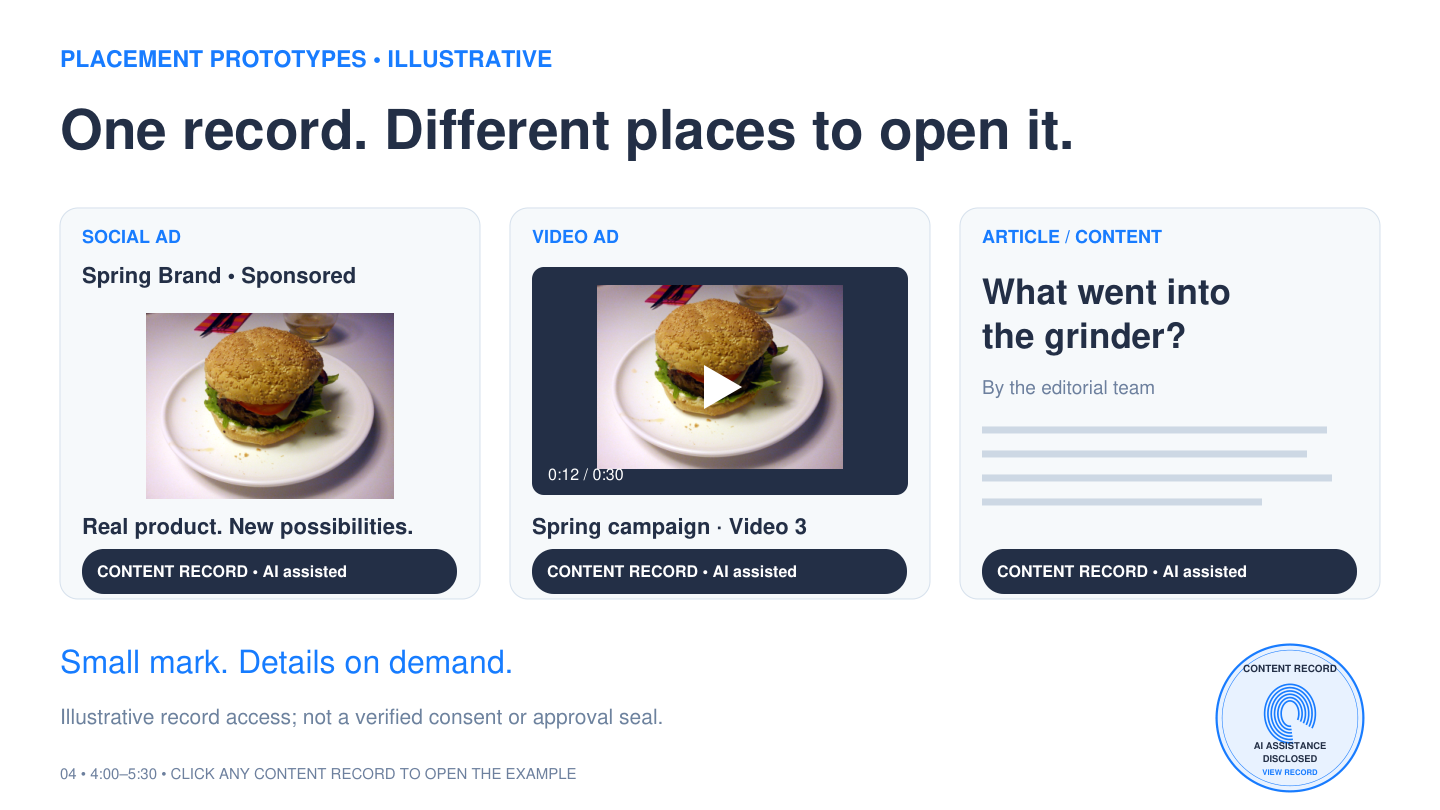
CONTENT RECORD◎CHECKEDVIEW EVIDENCEOne shared insignia, with its current status. Click it to inspect the record. A badge alone never proves compliance.
Connected receipt / OG-003
What happens next: Continue approved use. Check again if the asset or permission changes.
Public: decision, scope, version and review status. Auditor: private identity and supporting evidence. People can challenge the record; the reviewer records the response.
The evidence we already expect

Beef can combine many inputs. An AI ad can combine a real photo, a synthetic voice, and licensed work. The ingredients need a history.
cyclonebill / Wikimedia Commons · source · CC BY-SA 2.0 · displayed at smaller size.
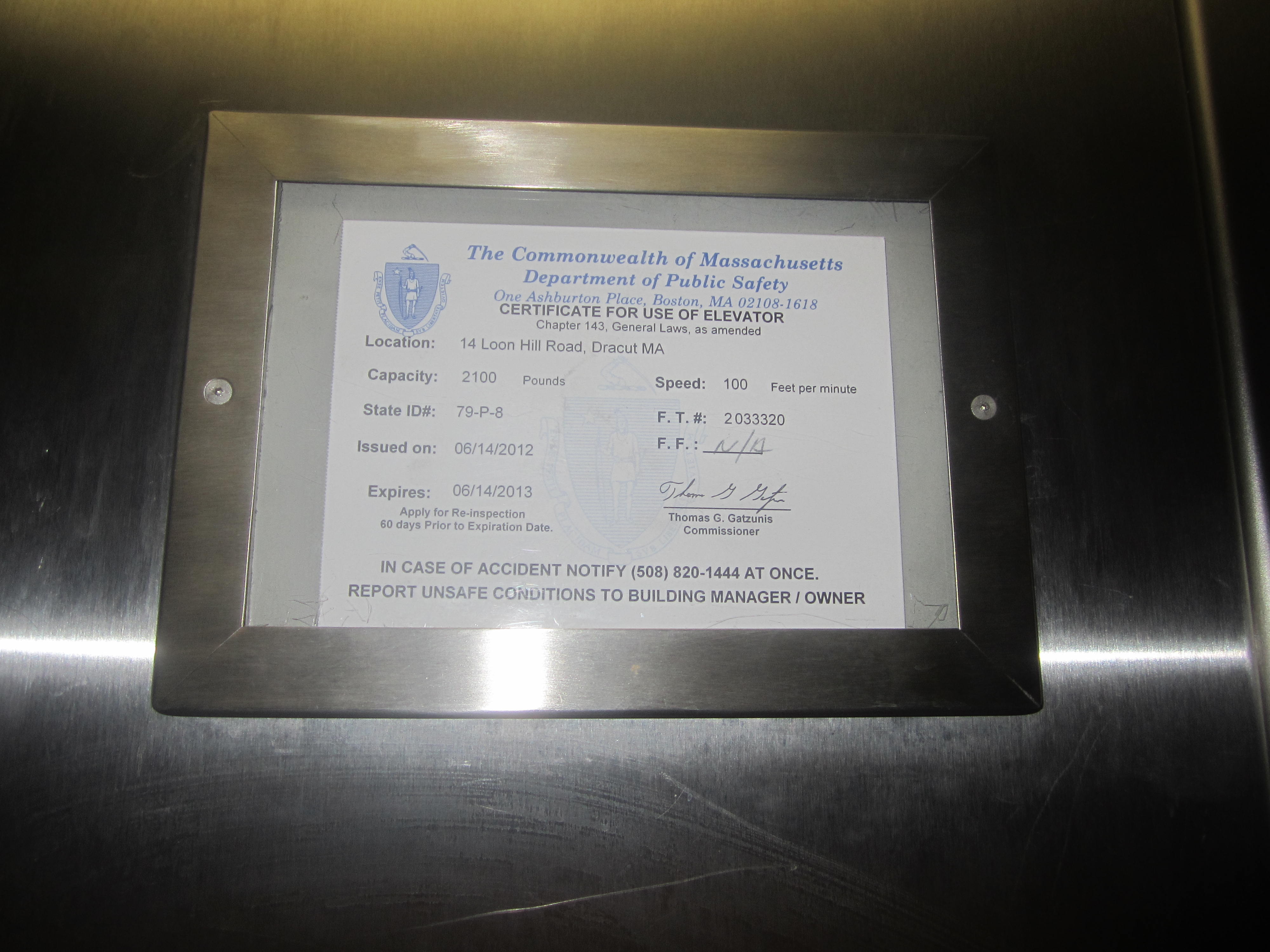
The certificate records an inspection, its date, and validity. An ad receipt should make approval and authority equally easy to inspect.
NWRGeek / Wikimedia Commons · source · CC0 · historical 2012–2013 certificate.

Mined or lab-grown? What supports the origin and quality claims? Appearance alone cannot answer the questions behind a purchase.
Public-domain diamond photograph · Rawpixel / CC0 source.
Art and used cars make the same point: a convincing Picasso needs evidence, and “one careful owner” invites a request for service history. These analogies explain why we ask for records; they do not guarantee truth or safety.
The whole effort
The Institute for Advertising Ethics Governance Lab identifies emerging risks and develops practical standards for accountable advertising, with IEEE Standards Association identified as a knowledge partner. The developing AI Advertising Trust Stack brings governance, technical evidence, and accountability into the same conversation.
Our Layer 4 contribution addresses the paper trail. It does not replace the other workstreams or speak on behalf of IAE or IEEE. The broader effort needs advertisers, creators, technologists, platforms, auditors, and people affected by advertising to help define what justified trust requires.
Define who can approve, when work must stop, and how problems escalate.
Record sources, permission, decisions, changes, and evidence bound to a version.
Audit, investigate disputes, assign responsibility, and support correction.
These are the adjacent workstreams relevant to this example, not a complete specification of the entire Trust Stack. Read IAE’s official Governance Lab overview ↗.
Progress update · 11 October 2026
This is developing work, not an adopted IEEE standard, certification scheme, or completed end-to-end system.
The next discussion is the IAE event at Omnicom on 12 October 2026. The goal is to test requirements and open questions, not announce that these controls are finished.
Progress updates on this page are dated and added as the work develops. No automated reporting or mailing-list subscription is implied.
Layer 4 · five questions
| Question | What the evidence should show | How someone uses it |
|---|---|---|
| Where did it come from? | Creator, tools, sources, AI use, and gaps. | Check origin, credit, and ownership claims. |
| What can it be used for? | Consent, license, region, purpose, expiry, withdrawal. | Test a disputed use against permission. |
| Who is responsible? | Decision, approver authority, presence evidence, company. | Find who controlled the step and hear their response. |
| What changed? | Edits, transformations, version fingerprint. | Determine if a later version exceeded approval. |
| How can it be checked? | Public checks and protected supporting evidence. | Audit without publishing private identities. |
Provenance is not truth. A presence check is not authority. A label alone is not permission. Those distinctions shape what the record must prove.
Small mark · deeper evidence
Our everyday examples start with diamonds, art, used cars, beef, and elevator certificates. We already ask for origin, permission, history, and inspection evidence elsewhere. Why should data or AI be different?
Contributions and boundaries
Narrative, permission and accountability questions, stakeholder use, and the connection between evidence and decisions.
Layer 4 technical collaboration: source collection, detection signals, privacy-preserving approval checks, and record carriage.
Compare what a person permitted with what the system actually did. Assign a correction owner and check the result.
C2PA and other standards provide existing components. The full record and governance around it remain proposals. ChatGPT assisted with this page, deck, and prototype implementation. The source register distinguishes actual production facts, attributed discussion, research references, and fictional examples.
Read the contributor and source table ↗Proposal for discussion
Creators disclose. Brands and agencies require proof. Platforms carry it. Auditors test it. Buyers and insurers evaluate it. People and rights holders can inspect and challenge it.
The proposal is to value checkable evidence in purchasing, distribution, and risk review. That is not a promise of lower insurance premiums, guaranteed reach, or an existing certification.
Explore the ecosystem and incentives ↗Follow the AI Advertising Trust Stack work.
What should the minimum record contain? Who should verify it? What would make it useful to your team or fairer to an affected person?
.jpg)
